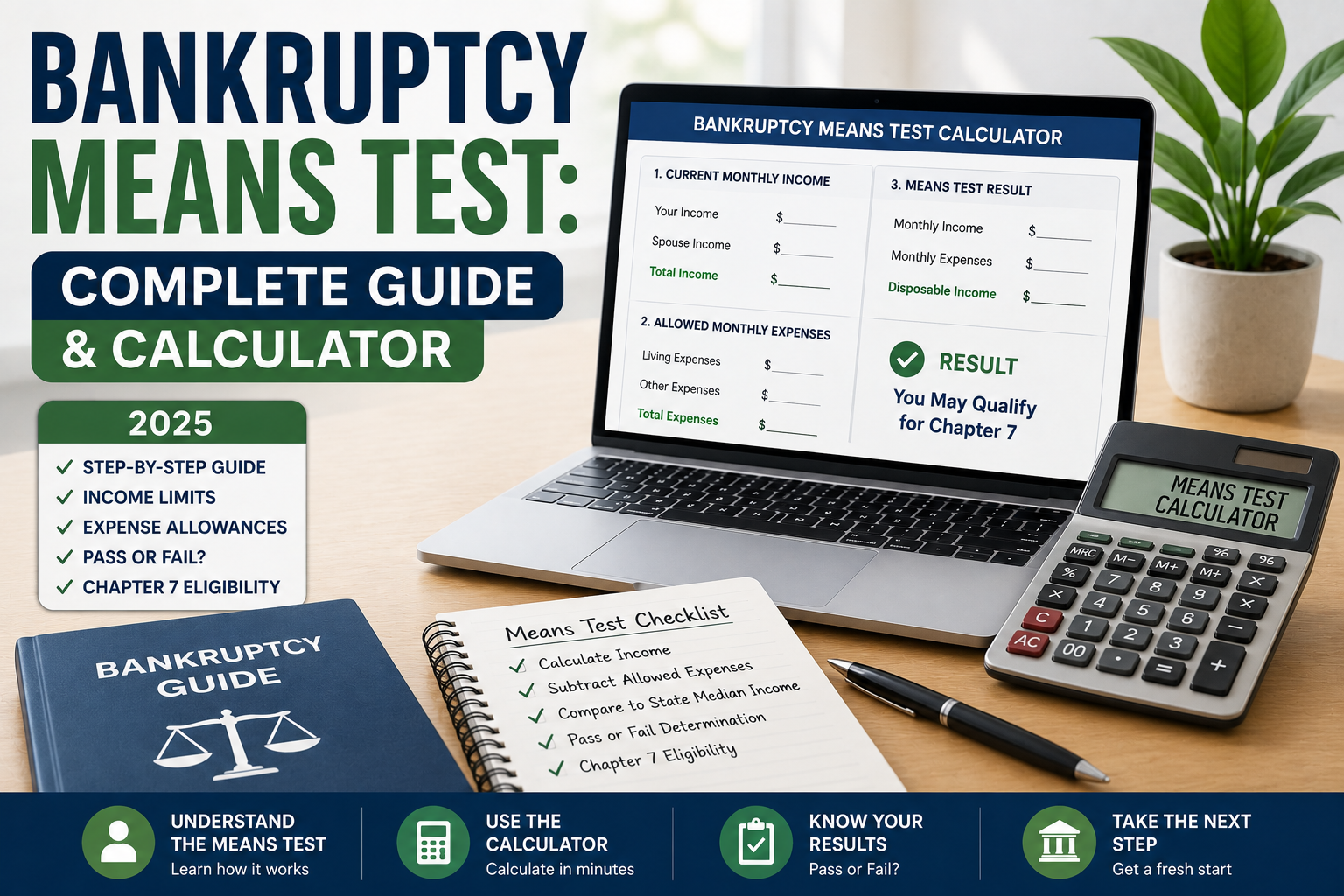
Bankruptcy Means Test: Complete Guide & Calculator 2025
6 mo — Period of income averaged for the means test (the 6 months before your filing date)
$0 — Cost to calculate means test using free tools at uscourts.gov or legalconsumer.com
<$167 — Monthly disposable income threshold that automatically qualifies you for Chapter 7
100% — Of Social Security income excluded from means test — a critical and often-missed exemption
50%+ — Estimated percentage of Chapter 7 filers who pass automatically (income below median)
What Is the Bankruptcy Means Test?
Created by the 2005 BAPCPA bankruptcy reform, the means test prevents higher-income people from using Chapter 7 bankruptcy when they have the ability to repay creditors through Chapter 13. It’s a two-part mathematical calculation — not a subjective judgment — that compares your income to your state’s median and your allowable expenses to IRS standards.
Pass = file Chapter 7 and discharge unsecured debts in 3–6 months with no payments to creditors. Fail = directed to Chapter 13 (a 3–5 year repayment plan). Getting this calculation right is critical.
Part 1: The Median Income Comparison
Calculate your average monthly income over the 6 calendar months before your filing date. Include: wages, self-employment income (gross, before expenses), rental income, pension, unemployment benefits, regular contributions from others. Completely exclude Social Security benefits — this is the most important and most-missed exemption in the entire test. Multiply your monthly average by 12 for your annual comparison figure.
Compare to your state’s median income for your household size (updated every 6 months at justice.gov/ust/means-testing). If your annual figure is below the state median — you automatically qualify for Chapter 7. No Part 2 needed. File immediately.
Part 2: Expense Deduction Calculation
Part 2 subtracts all allowed monthly expenses from your income to calculate ‘disposable income.’ Allowed expense categories:
| Expense Category | How Calculated | Where to Find Amounts |
|---|---|---|
| Food, clothing, personal care | IRS National Standards by household size | irs.gov/collection-standards |
| Housing and utilities | IRS Local Standards by county | irs.gov/local-standards |
| Transportation | IRS Local Standards + actual loan/lease payments | irs.gov/local-standards |
| Health insurance premiums | Your actual monthly premium amount | Pay stubs or premium statements |
| Secured debt payments | Average monthly mortgage and car loan payments | Mortgage and loan statements |
Pass/Fail Thresholds
After subtracting all allowed expenses from monthly income: disposable income under $167/month = pass. Over $278/month = fail. Between $167–$278 is a gray zone requiring additional calculation. Always verify current thresholds at justice.gov/ust before filing — they are periodically adjusted.
Common Mistakes That Cause Unnecessary Failures
Not deducting health insurance premiums ($300–$600/month). Using actual housing costs when IRS Local Standards are sometimes higher. Forgetting retirement contribution deductions. Not deducting childcare or elder care expenses. Missing 401(k) loan repayment deductions. Each omission can push you from qualifying for Chapter 7 into Chapter 13 unnecessarily.
For the full filing process: How to File Chapter 7 Bankruptcy Yourself | For choosing between types: Chapter 7 vs Chapter 13 Bankruptcy
Frequently Asked Questions
Is Social Security income excluded from the means test?
Yes — completely excluded. Social Security benefits (retirement, disability, SSI) are not counted in means test income. This is one of the most important and most commonly missed exemptions. If most of your income is Social Security, you very likely qualify for Chapter 7 regardless of the total amount.
Can I strategically time my filing to pass the means test?
You can legally time your filing. If you recently lost a high-paying job, waiting until the 6-month average drops below the state median makes strategic sense. Courts scrutinize unusual timing, so consult a bankruptcy attorney about the best timing for your specific situation.
How does self-employment income work in the means test?
Self-employed filers include business income minus actual business operating expenses (supplies, mileage, software, etc. — not personal expenses) in their means test income figure. This can significantly reduce your calculated income. Keep detailed business expense records.
Where can I calculate the means test for free?
Free means test calculators: legalconsumer.com/bankruptcy (most beginner-friendly), bankruptcyinpublication.com, and the official Form B122A-1 from uscourts.gov. Most bankruptcy legal aid organization websites also offer free calculation tools.
I failed the means test — what are my options?
You can file Chapter 13 instead — it has no income limit, only requiring regular income to fund the repayment plan. Alternatively, consult a bankruptcy attorney — some deductions that aren’t immediately obvious may still qualify you for Chapter 7 after all.
How current are the median income figures?
The U.S. Trustee Program updates median income figures every 6 months using Census Bureau data. Always use the figures in effect on your actual filing date at justice.gov/ust/means-testing. Never rely on figures from any article — including this one — that may be months out of date.
Run the Numbers Before You Assume the Answer
Many people assume they earn too much for Chapter 7 without actually doing the calculation. The Part 2 expense deduction routinely qualifies people whose incomes are 20–40% above the state median once all allowed deductions are properly applied. Spend one hour with the free calculator before giving up on Chapter 7.